+86-15625231989
 deborra@dcolorpaper.com



Non-Toxic Adhesive for Eco-Friendly Thermal Sticker Label
The development of non-toxic adhesives represents a significant advancement in creating truly eco-friendly thermal sticker label products. This innovation is particularly crucial for direct thermal label applications where material safety and environmental impact are growing concerns, especially in popular formats like the 4×6 direct thermal label used across various industries.

Safety Standards for Thermal Sticker Label
The adhesive formulation used in thermal sticker label products directly impacts both user safety and environmental compatibility.
• Modern thermal sticker label products utilize adhesives free from heavy metals, solvents, and toxic residues. These advanced formulations maintain strong adhesion while ensuring safety during handling and application.
• The non-toxic adhesive in thermal sticker label applications demonstrates excellent stability under various environmental conditions. It provides reliable performance without releasing harmful substances, making it suitable for food packaging, pharmaceutical labeling, and other sensitive applications.
Products Description
| Product Name | Thermal Label |
| Premium Quality | Water Proof,Oil Proof,Scratch Proof,Strong Adhesive and dark printing image |
| Colour | White/Yellow/Blue |
| Release paper/Liner | 60gsm glassine paper |
| Adhesive feature | Strong initial adhesive and long time storage life ≥3years |
| Service Temp | -25℃~+65℃ |
| OEM | Color, Logo, Brand On Label/Carton Available Design Service FOR FREE! |
| Packing | Waterproof bag+Carton |
| Certification | ISO, FSC |
Environmental Benefits of Direct Thermal Label
The direct thermal label technology inherently supports environmental goals through its efficient manufacturing process and reduced material usage.
• Direct thermal label products eliminate the need for ink ribbons or toner cartridges, significantly reducing waste generation. This streamlined approach complements the eco-friendly adhesive systems to create a more sustainable labeling solution.
• The combination of non-toxic adhesive with direct thermal label technology creates products that are easier to recycle. Unlike traditional labels, these materials don’t introduce chemical contaminants that could compromise recycling processes.
Applications for 4×6 Direct Thermal Label
The 4×6 direct thermal label format has become increasingly popular in logistics and retail sectors, where non-toxic adhesive properties provide distinct advantages.
• 4×6 direct thermal label products with non-toxic adhesives offer superior performance in shipping and logistics. They maintain secure attachment through various handling conditions while ensuring package recyclability.
• The safety profile of non-toxic adhesives makes 4×6 direct thermal label products ideal for retail environments. They’re particularly valuable for products requiring direct food contact or those targeting environmentally conscious consumers.
4×6 Direct Thermal Label FAQs
Q: Can a Thermal Sticker Label be used for outdoor applications like shipping pallets, or will it fade/peel quickly?
A: It depends on the type of Thermal Sticker Label—standard options work best for indoor use, but “outdoor-rated Thermal Sticker Label” is designed for outdoor applications like shipping pallets. These have water-resistant coatings, UV protection (to prevent fading in sunlight), and heavy-duty adhesive that resists peeling in temperature swings (-20℃ to 60℃). For long-term outdoor use (3+ months), choose labels with a matte or gloss laminate—this adds an extra barrier against rain, dust, and scuffs. Standard Thermal Sticker Label will fade or peel within 1-2 weeks outdoors, so always confirm “outdoor compatibility” before purchasing.
Q: What’s the difference between a 4×6 Direct Thermal Label and a regular Direct Thermal Label, and why is 4×6 so common for shipping?
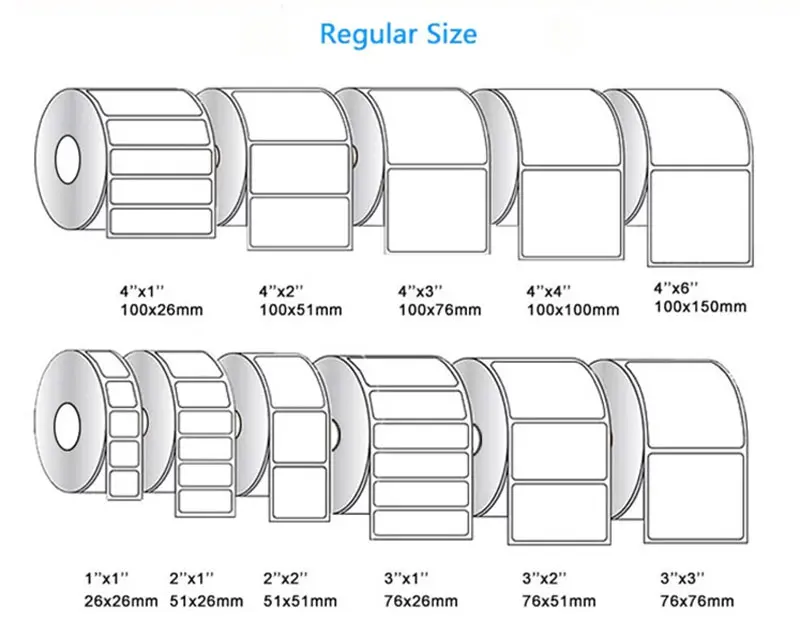
A: A 4×6 Direct Thermal Label is a specific size of Direct Thermal Label (4 inches wide x 6 inches long)—the key difference is dimensions, not material (both use heat-sensitive paper, no ink). The 4×6 size is industry-standard for shipping because it fits all major carriers’ (USPS, FedEx, UPS) label requirements: it has enough space for barcodes, shipping addresses, tracking numbers, and carrier logos without being too large to fit on packages. Regular Direct Thermal Label comes in smaller sizes (e.g., 2×3 for price tags) or larger sizes (e.g., 8×11 for pallet labels), but 4×6 balances readability and package fit—making it the go-to for e-commerce and shipping.
Q: How do I store 4×6 Direct Thermal Label to keep them from losing print quality, especially if I buy in bulk?
A: To preserve print quality of 4×6 Direct Thermal Label (especially bulk orders), store them in a cool, dry area—ideal conditions are 60-75°F (15-24°C) with 30-50% humidity. Avoid direct sunlight, heat sources (e.g., near printers or heaters), and moisture (e.g., basements or near sinks)—heat and humidity can activate the thermal coating prematurely, causing labels to darken or smudge. Keep unopened rolls in their original packaging (usually plastic with a moisture barrier) until use, and once opened, seal the roll with a clip or plastic bag to prevent exposure. Proper storage extends shelf life to 1-2 years; poor storage can reduce it to 3-6 months.
Q: Will a Thermal Sticker Label stick to all surfaces, like plastic, cardboard, and metal? Or do I need different adhesives?
A: A standard Thermal Sticker Label works well on smooth surfaces like cardboard and plastic, but not all—adhesive type matters for tricky surfaces. For metal (e.g., tool labels) or textured plastic, choose “high-tack Thermal Sticker Label” with aggressive adhesive that bonds to uneven or non-porous surfaces. For cold surfaces (e.g., freezer items), opt for “freezer-grade Thermal Sticker Label” with adhesive that stays sticky at sub-zero temperatures. For temporary use (e.g., removable product tags), select “repositionable Thermal Sticker Label” with low-tack adhesive. Always check the label’s “adhesive compatibility” specs—using the wrong adhesive will lead to peeling or falling off.
Q: Do Direct Thermal Label require a special printer, or can I use a regular inkjet/laser printer?
A: Direct Thermal Label require a thermal printer—they won’t work with regular inkjet or laser printers. Thermal printers use heat to activate the heat-sensitive coating on Direct Thermal Label, creating text or barcodes—no ink, toner, or ribbons needed. Inkjet/laser printers rely on ink or toner, which won’t bond properly to thermal paper (the ink may smudge, and the thermal coating won’t activate). Most thermal printers are designed for specific Direct Thermal Label sizes (e.g., 4×6 for shipping, 2×3 for tags), so confirm your printer’s size compatibility before buying labels. While thermal printers have an upfront cost, they save money long-term (no ink replacements) for businesses that use Direct Thermal Label regularly.
-
No articles can be displayed。
please send messager here, our team will respond within 24-48 hours.